fire department
Love in the Time of CholeraThe fire department begins as a civic improvement in a city where organized emergency services are new, then becomes an improvised rescue force when Juvenal Urbino summons it to retrieve his parrot from a mango tree. Its bungled operation damages the household and fails to recover the bird; the next day, Urbino climbs after the parrot himself and falls to his death. The episode gives the service a double significance: it represents the practical modernization Urbino promotes, yet its noisy, destructive intervention helps set in motion the fatal sequence it was meant to prevent.
Creation and Civic Purpose
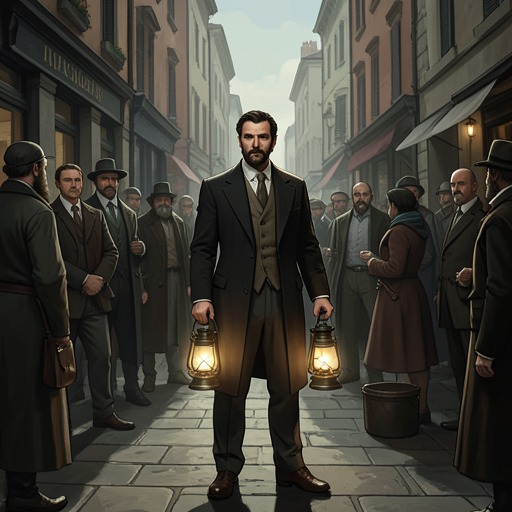
Until recently, fires had been fought by volunteers with bricklayers’ ladders and buckets carried from wherever water could be found. The disorganized methods could cause damage comparable to the fires themselves. A fund organized by the Society for Public Improvement, whose honorary president was Urbino, had established a professional corps and supplied it with a water truck, a siren, a bell, and two high-pressure hoses. The service was popular enough that when its alarm sounded, classes were suspended so children could watch the firemen at work.
Urbino helped broaden the corps’s responsibilities beyond firefighting. He had seen firemen in Hamburg revive a boy found frozen in a basement after a three-day snowstorm, and in Naples he had seen them lower a coffin from a tenth-floor balcony when a twisting stairway blocked its passage. He cited such examples to encourage the local authorities to use firemen for other emergencies, including forcing locks and killing poisonous snakes. The Medical School also offered them a course in first aid for minor accidents. In that context, asking the service to rescue a parrot seemed a reasonable extension of a new civic role.
The Parrot Rescue
When the parrot escaped to the top of the mango tree, Urbino and the household had already spent three hours trying unsuccessfully to lure it down. The bird answered Urbino in Spanish, French, and Latin, matching his emphasis and tone, but would not leave its perch. Convinced it would not descend voluntarily, Urbino sent for the fire department before going to dress for a gala luncheon. At the time, he was devastated by a letter from Jeremiah de Saint-Amour and did not truly care what happened to the parrot.
The rescue became a source of extensive damage. The firemen used their pressure hoses in an attempt to frighten the parrot down, stripping branches from the tree and sending water through the windows of the master bedroom. The water damaged furniture and portraits, while the crew muddied the terrace and drawing room and tore Fermina Daza’s favorite Turkish rug. Neighbors, believing there was a fire, rushed to the house when they heard the truck’s bell. The firemen then tried to reach the bird with extension ladders and began cutting branches with machetes; Marco Aurelio Urbino Daza arrived in time to stop them from cutting the tree back to its trunk.
The operation achieved nothing. The firemen said they would return after five o’clock if given permission to prune, but the parrot appeared to have escaped through neighboring patios. Urbino searched the foliage without receiving an answer and eventually gave up. After his siesta, however, he discovered that the bird was still in the tree. The service’s failure left the parrot within reach of Urbino’s own later attempt, but the text does not establish that the firemen’s actions caused his fall.
Urbino’s Fall and the Service’s Consequence
The following day, Urbino approached the parrot with his walking stick, then climbed the household ladder when the bird moved to a branch he thought he could reach. He climbed higher than intended, caught the parrot around the neck, and immediately let it go as the ladder slipped. He fell and died at seven minutes after four on Pentecost Sunday. The fire department did not directly cause the accident: the fatal fall occurred during Urbino’s own attempt to retrieve the bird after the earlier rescue had failed.
The sequence turns an ordinary civic request into a domestic calamity. A professional service created to replace chaotic volunteer firefighting arrives with equipment and public authority, yet its effort produces collateral damage and leaves the original problem unresolved. Urbino’s fall completes the bitter reversal: the man who had organized the rescue and expanded the firemen’s remit dies in an attempt to finish the task himself.
Public Health and Modernization
The fire department belongs to a broader program of civic reform associated with Urbino. He campaigned against unsafe water, inadequate sewage, and the disposal of garbage in the mangroves; he also sought public instruction in building latrines. His approach to the firemen similarly treated public service as something that could be professionalized, expanded, and supported through training. The rescue episode does not erase those ambitions, but it reveals the gap between institutional improvement and reliable results: equipment and expertise can extend a service’s reach without ensuring that it will act effectively in every circumstance.
That tension also appears in the city’s response to disease. During an earlier cholera epidemic, the garrison fired a cannon every quarter hour because of a local belief that gunpowder purified the air. When a later suspected case arrived by schooner from Curaçao, Urbino instead alerted colleagues and authorities, sought warning and quarantine measures at neighboring ports, and restrained a military commander who wanted to return to cannon fire and martial law. The comparison clarifies the reforming ideal behind his civic work: replace inherited, ineffective responses with organized public measures. The firemen’s clumsy parrot rescue provides a smaller, comic and ultimately tragic counterpoint to that ideal.